
Skip to content
Healthcare Blog | Expert Insights & Medical Updates

Healthcare Blog | Expert Insights & Medical Updates

Astron Healthcare

Menu
Menu
JCI Accreditation

JCI Accreditation: Why Staff Training Matters as Much as Documentation

Posted on September 25, 2026September 25, 2026 by Astron HealthCare

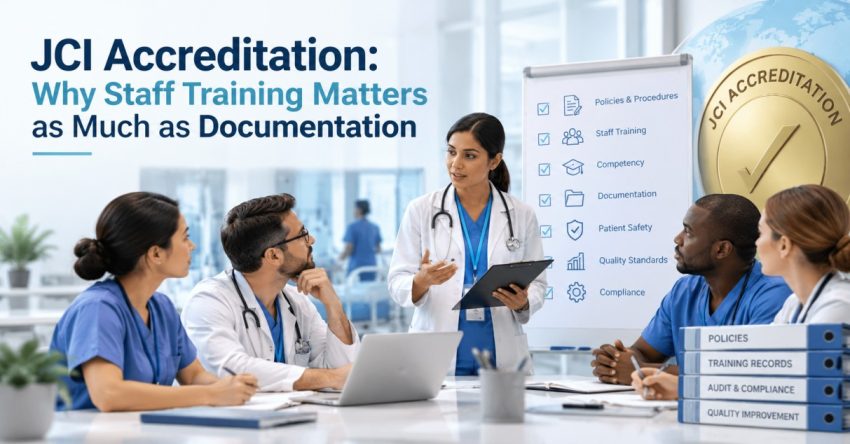
Paperwork is not the only way to get accredited in the healthcare sector. Policies, procedures, records and quality documentation are all evidence of a hospital’s systems but only effective if staff implements them consistently. The hospital must also pay particular attention to documented processes and to all people who are involved in implementing the processes in order to meet the requirements for JCI accreditation of a hospital.

Table of Contents

Toggle
  • Documentation Provides a Frame of Reference
    • Using procedures in everyday practice
    • Where training can enhance Readiness
    • Raising the stakes across departments
  • Transforming Training into a continuous task
    • Frequently Asked Questions
      • Why is staff training as important as documentation for JCI accreditation?
      • Can a hospital get JCI accredited with strong documentation but weak training?
      • Which staff members need JCI-related training?
      • What topics should a JCI training programme cover?
      • How often should staff be retrained for accreditation readiness?
      • Is general awareness training enough for JCI compliance?
      • How do hospitals know if training actually worked?
      • What's the difference between training completion and competency?
      • What records should hospitals keep for JCI training?
      • Who is responsible for reinforcing procedures on the ground?
      • What should staff do when they face a situation not covered by policy?
      • Does new staff onboarding count toward JCI readiness?
      • How does training help with patient safety specifically?
      • Can training reduce informal or inconsistent practices?
      • What's the real link between documentation and training?

Documentation Provides a Frame of Reference

There should be clear policies and procedures in place for patient safety, medication management, infection prevention, clinical care, emergency response and patient rights in the hospital. Documentation assists in setting the groundwork for what is expected, who is accountable and how processes are to be tracked.

But a policy is of little value if it is not known to employees, or if they have different understandings about what it means. Staff training is a key element in the accreditation readiness.

Using procedures in everyday practice

Training enables employees to be aware and understand how documented requirements are to be applied to their particular responsibilities. Accreditation processes may touch the lives of nurses, doctors, technicians, administrative staff, housekeeping staff and others in various ways.

For example, a patient identification policy might include certain checks before medication administration or clinical tasks are performed. Training helps relevant staff to be aware of these steps and to include them in their normal routine.

This correlation of written procedures and actual practice is especially relevant when hospitals undergo JCI accreditation, when they must show standards are being met throughout the organisation.

Where training can enhance Readiness

A structured training programme can be targeted to patient safety and compliance issues, such as:

  • Preventing infections and hand hygiene
  • Procedures for the safe use and administration of medications
  • Identifying and communicating with patients
  • Emergency response procedures
  • Incident reporting
  • Understand patient rights and confidentiality.
  • Medical record documentation
  • Fire and facility safety
  • All clinical equipment used is in working order and stored properly.
  • Department-specific quality procedures

Training should be tailored to job responsibilities instead of relying solely on general awareness sessions.

The program evaluates training outcomes through a measurement of whether training works.

Training is just one component of the process. Hospitals also should determine if staff has learned and applied the information.

There are a variety of ways to demonstrate practical understanding, such as knowledge assessments, demonstrations, competency evaluations, rounds of observation, and departmental audits. Records should also include proof of participation, assessment outcomes, gaps identified and any follow-up activities.

These measures aid management differentiate between the completion of training and actual competency.

Raising the stakes across departments

The more the responsibility for quality is spread throughout the organisation, the stronger accreditation readiness will be. Regular review, team discussions, audits, and feedback by the department heads and supervisors can help reinforce procedures.

Staff should also be familiar with where to get guidance when they come across situations which are not covered by the normal procedures. This means that consistency in decision making can be achieved, and informal practices can be minimized.

Transforming Training into a continuous task

Training of staff should not be viewed as a single event in preparation for an accreditation appraisal. It is important to orient new staff and to provide refresher training to current staff when changes in policy, technology, regulations, and/or clinical procedures occur.

Training coupled with ongoing monitoring can aid and maintain uniformity between standards and actual practice in hospitals seeking JCI accreditation.

Documentation sets the framework and trained employees make it come alive. By linking clear policies to training, competency assessment and continuous monitoring according to role, hospitals can develop robust quality, safety, and accountability systems.

Frequently Asked Questions

Why is staff training as important as documentation for JCI accreditation?

Because policies only work if staff actually understand and apply them consistently in daily practice.

Can a hospital get JCI accredited with strong documentation but weak training?

Not really — surveyors check whether staff can demonstrate the practices, not just whether policies exist on paper.

Which staff members need JCI-related training?

Everyone who touches patient care or safety — nurses, doctors, technicians, admin staff, and even housekeeping.

What topics should a JCI training programme cover?

Core areas like hand hygiene, medication safety, patient identification, emergency response, and incident reporting.

How often should staff be retrained for accreditation readiness?

It's ongoing — not a one-time event, with refreshers whenever policies, tech, or regulations change.

Is general awareness training enough for JCI compliance?

No, training works best when it's tailored to each role's specific responsibilities.

How do hospitals know if training actually worked?

Through assessments, demonstrations, competency evaluations, and observation rounds, not just attendance records.

What's the difference between training completion and competency?

Completion means someone attended a session; competency means they can actually perform the task correctly.

What records should hospitals keep for JCI training?

Proof of participation, assessment results, identified gaps, and follow-up actions taken.

Who is responsible for reinforcing procedures on the ground?

Department heads and supervisors, through regular reviews, audits, and team discussions.

What should staff do when they face a situation not covered by policy?

They should know exactly where to seek guidance, which keeps decision-making consistent.

Does new staff onboarding count toward JCI readiness?

Yes, orienting new hires on policies and procedures is a key part of staying survey-ready.

How does training help with patient safety specifically?

It ensures checks like patient identification and medication verification become second nature, not optional steps.

Can training reduce informal or inconsistent practices?

Yes, clear guidance and accessible support reduce the chances of staff improvising on their own.

What's the real link between documentation and training?

Documentation sets the standard, and training is what brings that standard to life in everyday care.

Also Read: JCI Accreditation Hospitals in India: Identifying Operational Gaps Before the Assessment

Leave a Reply Cancel reply

Your email address will not be published. Required fields are marked *

Send Query

    Recent Posts

    • JCI Accreditation: Why Staff Training Matters as Much as Documentation
    • JCI Accreditation Hospitals in India: Identifying Operational Gaps Before the Assessment
    • Hospital Design: Designing Critical Care Areas Around Safety and Accessibility
    • Healthcare Consulting Companies in India: Preparing Hospitals for Accreditation and Compliance
    • Management Consulting for Better Cost Control in Healthcare Facilities

    Categories

    • Astron Hospital and Healthcare Consultants
    • Building Plan Design
    • Healthcare Architecture Firms in India
    • Healthcare Consulting Firms
    • Hospital Architects
    • Hospital Consultant
    • hospital consultants in India
    • Hospital Consulting Planning
    • hospital designers & planners
    • Hospital Equipment Company
    • Hospital Management
    • hospital management consultancy in India
    • Hospital planning and design
    • Hospital Space Planners
    • JCI Accreditation
    • Management Consulting Companies
    • Management Consulting Firms
    • Management Consulting Services
    • medical equipment planning companies
    • NABH Guidelines for Hospital Construction
    • Project Management Consulting Company
    • Uncategorized

    Archives

    • September 2026
    • August 2026
    • July 2026
    • June 2026
    • May 2026
    • April 2026
    • March 2026
    • February 2026
    • January 2026
    • December 2025
    • November 2025
    • October 2025
    • September 2025
    • August 2025
    • July 2025
    • June 2025
    • May 2025
    • April 2025
    • October 2023
    • September 2023
    • June 2022
    • March 2022
    • February 2022
    • January 2022
    • October 2021
    • September 2021
    • August 2021
    • July 2021
    • June 2021
    • May 2021
    • April 2021
    • March 2021
    • February 2021
    • January 2021
    • December 2020
    • November 2020
    • October 2020
    • September 2020
    • August 2020
    • July 2020
    • June 2020
    • May 2020
    • April 2020
    • March 2020
    • February 2020
    • December 2019
    • November 2019
    • March 2019
    • December 2018
    • November 2018
    • October 2018
    • August 2018
    • July 2018
    • June 2018
    • May 2018
    • April 2018
    • March 2018
    • February 2018
    • March 2016
    ©2026 Healthcare Blog | Expert Insights & Medical Updates | Built using WordPress and Responsive Blogily theme by Superb
    imunify-bot-check

    Table of Contents

    ×
    • Documentation Provides a Frame of Reference
      • Using procedures in everyday practice
      • Where training can enhance Readiness
      • Raising the stakes across departments
    • Transforming Training into a continuous task
      • Frequently Asked Questions
        • Why is staff training as important as documentation for JCI accreditation?
        • Can a hospital get JCI accredited with strong documentation but weak training?
        • Which staff members need JCI-related training?
        • What topics should a JCI training programme cover?
        • How often should staff be retrained for accreditation readiness?
        • Is general awareness training enough for JCI compliance?
        • How do hospitals know if training actually worked?
        • What's the difference between training completion and competency?
        • What records should hospitals keep for JCI training?
        • Who is responsible for reinforcing procedures on the ground?
        • What should staff do when they face a situation not covered by policy?
        • Does new staff onboarding count toward JCI readiness?
        • How does training help with patient safety specifically?
        • Can training reduce informal or inconsistent practices?
        • What's the real link between documentation and training?
    → Index