
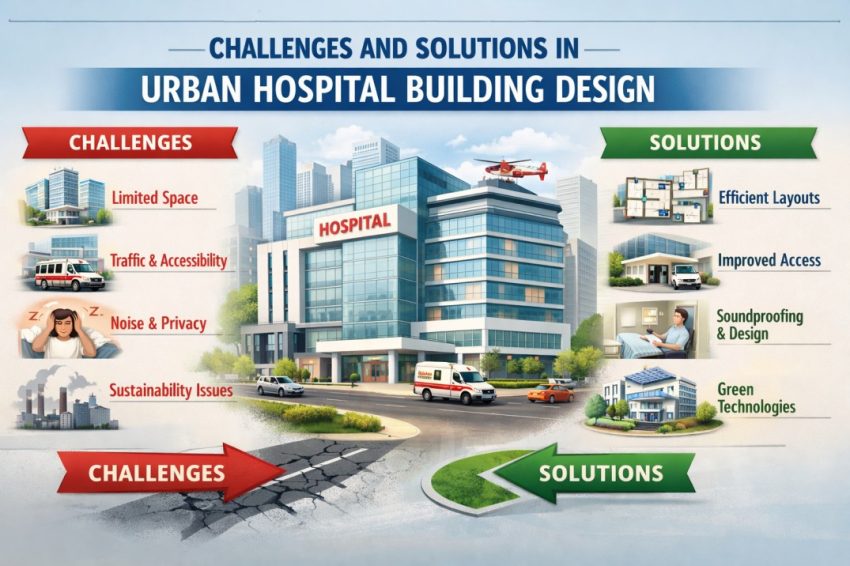
As cities continue to expand rapidly, the demand for advanced healthcare infrastructure is growing. Urban environments present unique constraints that make hospital building design both complex and critical. From limited space to rising patient volumes, architects and planners must balance functionality, efficiency, and patient comfort while navigating multiple challenges.
Space Constraints and Land Availability
One of the biggest challenges in urban hospital building design is the scarcity of land. Cities often have limited space, making it difficult to construct large healthcare facilities. Hospitals must accommodate various departments, advanced equipment, and patient care areas within confined footprints.
Solution: The most used strategy is vertical expansion. Hospital buildings with many stories and good floor planning permit the optimal utilization of the space that is available. The designers also dwell on modular designs that can be used when needs change thus remaining flexible without incurring the cost of acquiring new land.
Managing High Patient Volumes
Urban hospitals typically serve large populations, leading to overcrowding and long waiting times. Poor planning can result in inefficient patient flow, affecting both care quality and operational efficiency.
Solution: Designing of smart hospitals involves lean designs in which the patient routes, staff movement, and emergency are segregated. Strategic zoning of various departments lessens congestion as well as enhances overall working mechanisms. Efficiency is further promoted by the fact that digital systems are used in appointment scheduling, and tracking of patients.
Infection Control and Safety Concerns
In densely populated cities, controlling infections within hospitals becomes even more important. Improper ventilation, overcrowded waiting areas, and inadequate isolation facilities can increase the risk of disease transmission.
Solution: Modern hospital building design has focused on infection control by ensuring that their buildings are well ventilated, rooms should be in the negative pressure mode, and space between the patients should be ample. Easy to wash materials and antimicrobial surfaces are also in use to ensure hygienic standards.
Integration of Advanced Technology
Urban healthcare facilities must integrate cutting-edge medical technologies, which require specialized infrastructure. This can complicate the planning and construction process.
Solution: Future-proofed hospital construction design will have separate areas for hi-tech equipment, well-developed IT network, and scalable designs to meet needs of technological advancement. It is easier to plan digital integration at the original levels in order to facilitate easier operations and the flexibility in the long run.
Environmental and Sustainability Challenges
Urban construction often has a significant environmental impact. Hospitals, in particular, consume large amounts of energy and resources, making sustainability a major concern.
Solution: Green building of the hospital is concerned with energy saving equipment, natural light, and environmentally friendly resources. The green building practices include rain water harvesting, waste management system and integration of solar energy help reduce environmental impact while lowering operational costs.
Conclusion
Hospital design in urban is a complex endeavor that needs proper planning and creativity. Difficulties like space, large volume of patients, infection control, and sustainability should all be handled well. With a new approach to strategies and technologies, the design of hospital buildings will be able to address these challenges and design healthcare settings that are efficient, safe, and patient-centered.
The role of considerate and innovative design of hospitals is going to continue rising as the urban population constantly increases and the future of healthcare delivery in cities relies on the smart hospital building design.
Also Read: Why JCI Accreditation Matters for Hospitals Worldwide