
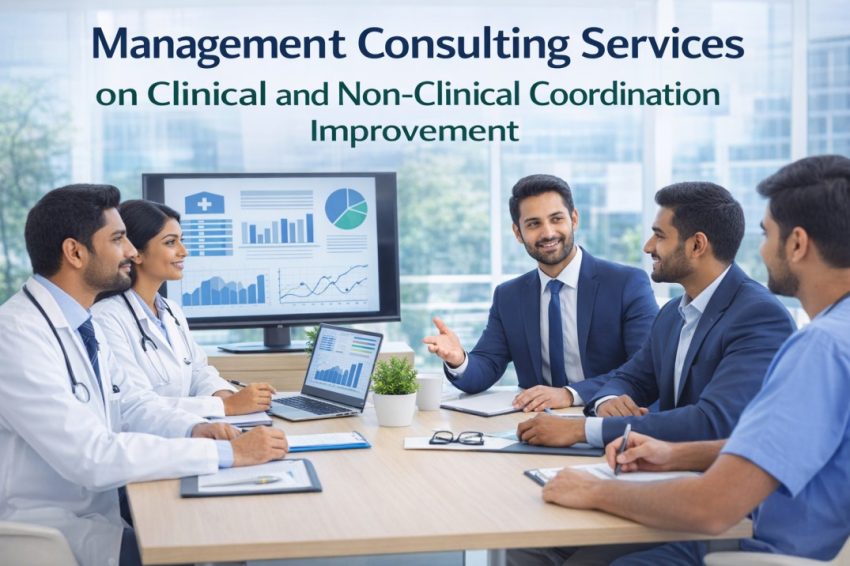
In healthcare organizations, the care of patients is not limited to the doctors and nurses. Throughout all successful treatment, there exist a system of administrative teams, support staff and operational processes. In cases where clinical and non-clinical teams operate independently, delays, errors, and non-satisfaction of patients may ensue. It is at this point that the management consulting services are important in enhancing coordination of the healthcare functions.
Understanding about the Coordination Gap in Healthcare
Clinical teams are concerned with diagnosis, treatment and recovery and non-clinical teams, with scheduling, billing, records and facility management. The essential information may be lost or delayed without proper coordination. The experienced management consulting services start with the identification of these gaps by the process reviews and interaction with the staff.
Through the current functioning of the departments, the consultants will be able to map coordination breakdown areas.
Standardizing Operations in Different Departments
Simplification of the work flows involving clinical and non-clinical teams is one of the most prominent goals of the management consulting services. This involves admission of patients, their discharge plans, test results, and follow up.
Definitive processes minimize work redundancy and make sure that each team has its part to play at each patient care phase.
Enhancing the communication channels
In health institutions, communication skills are critical. The management consulting services assist organizations to develop organized communication channels amongst the departments. This can be in terms of regular operating procedures, laid down escalation channels, and frequent coordination sessions.
With increased communication, patient information will flow efficiently that results in quick decision making and improved care outcomes.
Technology Systems Alignment
Technology tends to be the intermediary between the clinical and non-clinical teams. Management consulting services determine the utilization of the current systems and its effectiveness in coordination.
Consultants can align digital tools, record systems and reporting formats to ensure that all teams use the same source of information.
Role, Responsibility Clarification
Accountability may be a problem and role confusion may delay operations. Management consulting services- Healthcare organizations use these services to come up with clear roles of both clinical and non-clinical employees.
This is due to the fact that this clarity makes teams work with confidence and minimize the unnecessary overlap or delays in patient services.
Training and Change Management Support
It is necessary to enhance coordination by improving behavioural change, rather than by changing the processes. The services of management consulting help the healthcare organisations by training and managing change.
The employees are oriented to new working procedures and communication patterns, and it helps them to achieve the necessary changes without interfering with the routine.
Constant Improvement and Monitoring
The coordination process is a continual process. An effective management consulting services practice will entail establishing performance indicators and performance review systems.
The frequent checking up makes sure that the improvement in coordination is maintained and modified with growth and change of the organization.
Conclusion
Close interaction between clinical and non-clinical teams is critical towards effective and patient-centered healthcare services. Management consulting services assist healthcare organizations to overcome gaps, stream processes and enhance communication. These services contribute to smoother operations, enhanced patient experiences and stability in a long-term perspective of the organization by establishing alignment throughout teams.
Also Read: Importance of Zoning in Hospital Design Plan